

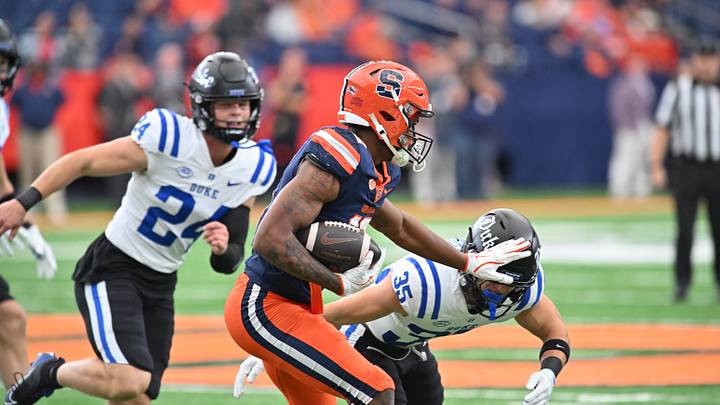
Some class of 2022 athletes, such as Syracuse basketball transfer commit Amarri Monroe and SU football wide receiver Justus Ross-Simmons, were dealt a setback on Friday in their respective attempts to gain a fifth season of eligibility.
The question becomes, what's next for Monroe, the 6-foot-7, 230-pound wing/forward from Quinnipiac, and the 6-foot-3, 210-pound Ross-Simmons, who was a senior for the Orange last year?
The most realistic way for Monroe and Ross-Simmons to play for the 'Cuse during the 2026-27 sports season, given Friday's news, is for them to strongly consider filing their own lawsuits in a state court, or attach their names to existing lawsuits at the state level where 2022 athletes have been granted a favorable injunction, numerous legal experts told Inside the Loud House in recent days.
NCAA statement:
— NCAA News (@NCAA_PR) August 21, 2026
The Tenth Circuit’s decision to stay the preliminary injunction issued by a Colorado federal district court judge in Wisne permits Division I to return to the status quo before the district court intervened. Effective immediately, the age-based eligibility rules…
Time is of the essence for football players such as Ross-Simmons, given that Syracuse's 2026 season begins in fewer than two weeks, on Saturday, Sept. 5, at home against non-conference foe New Hampshire. Basketball players, like Monroe, have more time, with the the Orange's 2026-27 campaign not officially getting underway until early November.
Friday's development was this: The U.S. Court of Appeals for the Tenth Circuit in Denver granted the NCAA's request to stay (i.e., pause) a preliminary injunction that was issued in late July by U.S. District Court of Colorado Judge Charlotte Sweeney. That class-wide injunction gave a fifth season of eligibility to 2022 athletes, provided they want one and with certain parameters.
With the stay granted, 2022 athletes who have already played four years in college and are relying solely on the federal injunction in the case of Wisne v. NCAA are not currently eligible to play in 2026-27. That federal case will now head to an appeal's hearing, and legal experts say it will be an expedited review, but how long this will take remains to be seen.
Some legal experts told Inside the Loud House it could last a few weeks, while others say it could drag on for several months. Either way, college football players don't have that kind of time. Even basketball players such as Monroe probably don't want to solely rely on seeing if the appeal process results in a favorable outcome.
Spent three hours driving to Philly on the phone with coaches and players - all with the same question: what’s this mean?
— Ryan P. Mulvaney (@ryanpmulvaney) August 21, 2026
All it means is that the District of Colorado’s decision granting eligibility to 2022ers is hold. The Tenth Circuit has not yet addressed the ultimate merits… https://t.co/uqlKRn71dY
"Relying on the federal appeals process is ... too risky. The circuit court may overturn the injunction on substantive merits, in which case everyone who did not file their own separate lawsuit or try to join another would be out of luck," Ryan Mulvaney, a shareholder in the Elmwood Park, N.J., office of law firm Stevens & Lee, told Inside the Loud House this weekend.
Attempts by Inside the Loud House to reach Monroe and Ross-Simmons, and their family members or other representatives, were not immediately successful this weekend. That being said, I am confident in stating that both these Syracuse Orange athletes are likely reviewing their legal options and in regular communication with the SU basketball and football coaching staffs.
Amarri Monroe of Syracuse basketball and Justus Ross-Simmons of Orange football are trying to get a fifth season of college eligibility.
This whole legal mess enveloping the country as the 2026 college football season is nearly here centers on the NCAA's new 5-for-5 eligibility model, which was approved in late June but does not allow 2022 athletes, who have already played four years in college, a fifth year of eligibility.
Naturally, the NCAA could have avoided this situation by merely affording 2022 athletes a fifth season of eligibility under the new 5-for-5 model, but alas, the NCAA didn't do that, and here we are.
In recent weeks, there have been favorable injunctions granted to 2022 athletes in the same situations as Monroe and Ross-Simmons at the state level, and that's why legal experts say it's wise for them to consider taking similar action.
At the time of this writing, Inside the Loud House was not aware of either Monroe or Ross-Simmons having filed their own lawsuits in state court or attaching their names to an injunction issued at the state level. Legal experts say that Friday's decision, though, will likely result in more state lawsuits filed as early as this week.
"First, if Amarri or even Justus wants to file something, it should not take long. They would have to retain counsel who is familiar with these developments and the industry, that attorney would file an emergent application for injunctive relief, and a hearing would be expeditiously conducted by the court after a very short expedited briefing schedule. That can happen in a matter of two weeks," Mulvaney said.
In a telephone interview on Sunday with Inside the Loud House, Jason Setchen, an attorney with Athlete Defender in Miami, said that if a 2022 athlete files a lawsuit in a state court and is requesting a preliminary injunction, given that an emergency petition would be filed, the process can potentially happen in 30 days or less.
But, as Setchen and other legal experts noted, a preliminary injunction requires the plaintiff to show four things: A likelihood of winning the case on its merits, irreparable harm, that the harm to the plaintiff outweighs harm to the defendant, and the overall public interest and/or community welfare would be best served by the injunction being granted.
For a football player such as Ross-Simmons, is it realistic that he could file his own lawsuit in time to potentially play in the Orange's first game on September 5?
Let me clear something up. Colorado suit wasn’t overturned-the injunction was stayed pending the expedited appeal. That being said,Colorado is a complex antitrust issue. In KY we filed and won arguing the NCAA bylaws are a contract the NCAA breached. Cleaner and simpler case.
— Hans Poppe 📎📌 (@HansTheLawyer) August 21, 2026
Hans Poppe, the CEO and lead attorney of the Poppe Law Firm in Louisville, Ky., told Inside the Loud House: "They absolutely can get a case filed. We filed ours 24 hours after being retained. Just have to draft and file a suit for injunction. As soon as a judge is assigned (minutes to hours), you call chambers and ask for an emergency hearing. Can all be accomplished this week if the lawyer knows what they are doing."
Earlier this month, former Syracuse basketball guard J.J. Starling, a 2022 athlete who has played four years in college, added his name to an injunction in California, according to Jon Rothstein of CBS Sports. Starling has also since entered his name into the transfer portal, per various reports.
Ross-Simmons and/or Monroe could do something similar, although several legal experts say that might be a lengthier process. For college football players who are currently in preseason training camp, that might be an issue with the 2026 campaign about to kick off.
Said Mulvaney: "With respect to joining another (lawsuit), counsel for existing plaintiffs in the existing cases would have to first request leave to amend to add a new party (new plaintiffs), and that process is usually a lengthy process. For instance, here in New Jersey federal court, a motion for a leave to amend a complaint runs on a 24-day schedule, meaning the motion would have to be filed on or before the 24th day before a motion return date (hearing date), with opposition due 14 days before and reply seven days before. In other words, just trying to amend the complaint - at least here in NJ federal court - takes a month."
Another question on my mind, and something that fans are talking about on social media and in chat rooms, is whether 2022 athletes such as Ross-Simmons and Monroe can continue practicing with their respective college teams if they're relying only on the Wisne v. NCAA federal case and thus, at present, aren't currently eligible.
Legal experts whom I spoke to weren't entirely sure about this. Some said they thought the 2022 athletes could continue practicing, because the preliminary federal injunction hasn't been thrown out; it's just been temporarily paused while the appeals process plays out.
At least one attorney whom Inside the Loud House spoke with this weekend said he didn't think these 2022 athletes could keep participating in team activities for the time being, unless they become part of a state-level injunction.
Full statement to @FOS from Wisne plaintiff attorney Rob Shelquist, who noted not all three of the judges in the Tenth Circuit agreed with the decision to stay the injunction pending appeal: pic.twitter.com/tAfrGpQ44e
— Amanda Christovich (@achristovichh) August 21, 2026
Mulvaney said: "As for practicing, that’s a difficult question ... that I have been fielding since Friday. At this point, that would be left to the discretion of the school/compliance/legal. By virtue of the 10th circuit pausing the district court’s ruling, players who were previously eligible by virtue of the district court’s decision are now no longer eligible."
This weekend, Inside the Loud House sent messages to Syracuse Athletics spokespeople, SU compliance officers and representatives of both the Atlantic Coast Conference and the NCAA. Those messages were not immediately returned, but if I get any responses, I will update this story as relevant.
 Add us as a preferred source on Google