

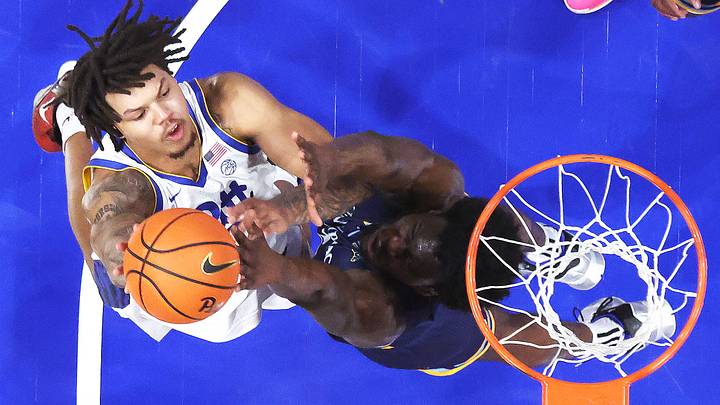
The U.S. Court of Appeals for the Tenth Circuit in Denver has granted the NCAA's request to stay (i.e., pause) a recent class-action lawsuit that had enabled class of 2022 athletes a fifth year of eligibility, according to multiple media reports on Friday.
For Syracuse basketball transfer commit Amarri Monroe, a 6-foot-7, 230-pound wing/forward from Quinnipiac, and SU football wide receiver Justus Ross-Simmons, this is not good news.
Both, as far as I can tell, have been relying on a preliminary injunction issued in late July by U.S. District Court of Colorado Judge Charlotte Sweeney that granted 2022 athletes, who had already play four years in college, a fifth season of eligibility.
Class of 2022 athletes who exhausted four years of eligibility this past spring are now ineligible unless they have their own TRO/injunction. https://t.co/TOgHKEusTw
— Pete Nakos (@PeteNakos) August 21, 2026
The NCAA's new 5-for-5 eligibility model, approved in late June, does not allow athletes who have already played four years in college another year of eligibility, which is the case for Monroe and the 6-foot-3, 210-pound Ross-Simmons.
As On3's Pete Nakos noted following news of the Tenth Circuit's decision to grant the NCAA's request to stay, "An expedited appeal hearing has been set. Class of 2022 athletes who exhausted four years of eligibility this past spring are now ineligible unless they have their own temporary restraining order or injunction."
Inside the Loud House is not aware of Monroe or Ross-Simmons having filed their own individual lawsuit in a state court or attaching their names to an ongoing injunction, several of which have been granted at the state level in recent weeks.
In a text message on Friday to Inside the Loud House, Ryan Mulvaney, a shareholder in the Elmwood Park, N.J., office of law firm Stevens & Lee, said that if Monroe or Ross-Simmons "didn’t file a separate state court case or (don't) do so, (they) won’t be eligible unless the 10th ultimately denies the NCAA appeal. Not sure I would wait that long if I were (them)."
Syracuse basketball transfer commit Amarri Monroe and SU football wide receiver Justus Ross-Simmons were dealt a setback on Friday.
I would expect today’s Tenth Circuit ruling to trigger another wave of state eligibility lawsuits.
— Austin Massey (@austinmasseySBI) August 21, 2026
Wisne was the nationwide federal safety net. With that injunction now stayed, Class of 2022 athletes who want to play may increasingly have to pursue individual relief in state… https://t.co/FBAplcF53e
It's possible that the Tenth Circuit's decision on Friday could result in more lawsuits over eligibility at the state level. In recent weeks, multiple legal experts have told Inside the Loud House that class of 2022 athletes who want more certainty about having a fifth season of eligibility should strongly consider filing their own lawsuits in a state court or adding their name to an existing lawsuit or injunction at the state level, which is what former Syracuse basketball guard J.J. Starling has done.
The 6-foot-4, 206-pound Starling, a Central New York native who is from Baldwinsville, N.Y., recently added his name to an injunction in California for athletes from the class of 2022. He has also since entered his name into the transfer portal.
Time is of the essence for 2022 athletes, especially those involved in college football or other fall sports. Syracuse football, for one, is currently in its preseason training camp, and the team's first game in the 2026 season is just over two weeks away. Ross-Simmons was cleared to join the 'Cuse earlier this week and began practicing, an SU Athletics spokesperson confirmed to Inside the Loud House in recent days.
Not long after Monroe committed to Syracuse basketball, I caught up with attorneys including Darren Heitner, the founder of the Heitner Legal PLLC law firm in Fort Lauderdale, Fla., who is currently representing many clients in lawsuits that have been filed at the state level.
At the time, Heitner told me that he didn't necessarily expect the federal injunction issued in Colorado to hold for the entire 2026-27 college sports season. "Athletes who want certainty are better off as named plaintiffs in individual state-court actions, several of which have already produced favorable injunctions," Heitner told Inside the Loud House earlier this month.
 Add us as a preferred source on Google