

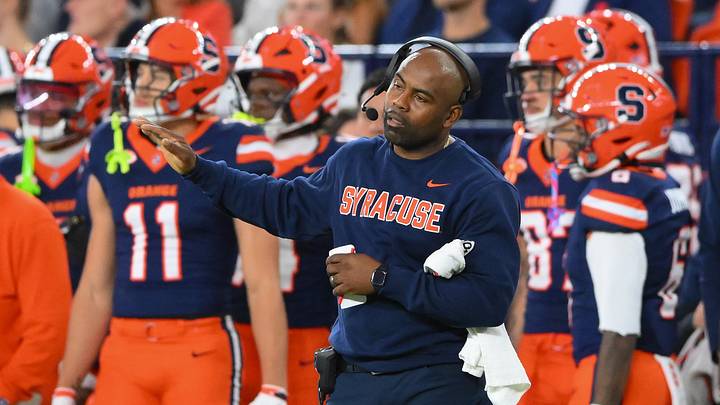
Frustration for the Syracuse football fanbase is at fever pitch. The Orange is 2-4 at the midway point of the season, including 0-4 in ACC play. Yet, Syracuse has been competitive in every game and probably should have won three of the games it lost. As frustrating as it is to see another season slip away in such painful fashion, it might help to make sense of why this keeps happening.
Why Syracuse has a chance in every game
Unlike last year, when it was one blowout after another following Steve Angeli’s injury, the Orange has had a fighting chance in every game this season. Believe it or not, there have been plenty of silver linings and things that Fran Brown and company have done right. Here are the three biggest reasons why the Orange remain a competitive team.
The defense has stood tall
The Syracuse defense is far from perfect. There is still no standout pass rusher; the incredible depth at cornerback has been used to fill holes at safety; and they’ve given up too many points as a result of foolish penalties that have kept drives alive for the opposing team. Yet, the Orange defense has continuously positioned Syracuse to win.
The Cal game likely would have been a win if not for Angeli’s pick-six. Virginia was limited to just seven points until late in the third quarter, when the offense’s struggles became too much to overcome. After a poor first half against Louisville, the Syracuse defense played well enough in the second half to win, only for the offense to fail to capitalize. In all three games, a little more consistency from the offense would have been enough for the defense to carry the Orange across the finish line.
Quarterback depth
To his credit, Brown didn’t get fooled twice. He failed to have adequate quarterback depth in place after Angeli’s injury last season. But Brown corrected that problem this season. In two of its six games, Syracuse has had to start third-string quarterback Malachi Nelson and finish with fourth-stringer Danny Lauter.
Needless to say, that’s far from ideal. There aren’t many teams that would be able to remain at all competitive with their third- and fourth-string quarterbacks on the field. Syracuse fans learned that the hard way during the Scott Shafer era. Yet, Nelson has played well enough to keep Syracuse competitive, while Lauter has kept hope alive when forced into the game under near-impossible circumstances. Without those players, the 2026 season would already be resembling the 2025 campaign.
Umari Hatcher
Hatcher has easily been the biggest silver lining of the season. Syracuse had limited answers at wide receiver - or running back, for that matter - ahead of the season. Playing four different quarterbacks in six games certainly doesn’t help consistency at the wide receiver position. But Hatcher has emerged as a superstar, regardless of who’s throwing the ball.
Hatcher was impossible to ignore 🍊
— ACC Digital Network (@theACCDN) October 18, 2026
Umari Hatcher set multiple single-game career highs, hauling in 13 catches for 224 yards and a TD against Louisville.@CuseFootball | @Cuse | #Cuse pic.twitter.com/i1GlOuYYhR
After torching both UConn and Virginia for a combined 278 yards and four touchdowns on 20 catches, one would have thought Louisville would have reshaped its defense to stop Hatcher. Instead, he came up with one of the best single-game performances by a wide receiver in program history, racking up 13 catches for 224 yards. Hatcher has given the Syracuse offense at least one star who has been able to make the types of game-changing plays that have kept them in games amidst a revolving door of quarterbacks.
Why Syracuse can’t seem to win
Now for the frustrating part. We’ve seen Syracuse hold a lead in the fourth quarter in two of its four losses, while trailing by just two points late in the Louisville game. So why can’t the Orange get over the finish line?
Ill-timed turnovers
On the season, Syracuse has a negative turnover ratio. While that’s not ideal, the bigger problem is the timing of the turnovers. Most have happened at the most inopportune moments. Angeli’s pick-six against Cal is the obvious example. The Orange also fumbled inside the five-yard line against Louisville rather than score a go-ahead touchdown. These have been critical turnovers at key moments that have completely changed the outcomes of games.
In total, Syracuse quarterbacks have thrown nine interceptions this season. Somehow, all have occurred in the second half when there is less time to make up for those mistakes. In other words, when the game is on the line, the Orange is making negative plays that swing things in favor of their opponents. Until that trend reverses itself, it’ll be hard to win games.
Detail and discipline
According to Brown, Syracuse is supposed to be detailed and accountable. But there simply hasn’t been enough DART this season. Slowly but surely, Syracuse is getting better at avoiding costly penalties. However, they are still among the nation’s worst teams when it comes to penalties and penalty yards. That’s not the sign of a team that’s detailed or disciplined.
"We won those games a couple of years ago."
— Cuse Sports Talk (@CuseSportsTalk_) October 18, 2026
Syracuse head coach Fran Brown following the loss to Louisville. pic.twitter.com/dwmnVLgcmi
Unfortunately, the lack of detail and discipline manifests in other ways as well. Many of the Orange’s turnovers are a result of not executing simple things like handoffs or understanding game situations in which surviving to play another down is better than making a risky pass. All of the little things that good teams do to come out on top are lacking for the Orange. Now in his third season as a head coach, it’s inexcusable for Brown to be struggling to instill those details in his team, especially when it’s supposed to be a core value of the program.
Red-zone struggles
Aside from being one of the worst offenders when it comes to penalties, Syracuse is also one of the worst red-zone teams in the country. The Orange is only scoring 78% of the time when reaching the red zone, scoring a touchdown just 58% of the time. Neither of those numbers is acceptable, especially when the Orange seems to be playing a one-score game every week. Those stats would have made sense last season, but when the team is playing competitive games, it makes all the difference.
Obviously, Syracuse’s kicking woes are well documented. Walking away from the red zone empty-handed after a missed kick is bad enough. But Jeff Nixon and the offense need to bypass that problem altogether by getting into the end zone. The offensive line is too big to get stuffed at the goal line the way Syracuse has at times this season. Perhaps the solution is taking more shots before space shrinks inside the red zone. Either way, the Orange’s poor performance in the red zone is a big reason why Syracuse is losing closing games.
 Add us as a preferred source on Google