

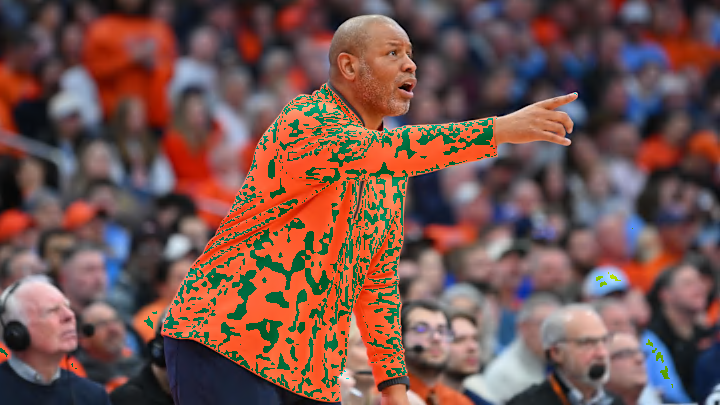
There’s no doubt that the college basketball season has been a painful one for Syracuse basketball fans. A talented roster has been utterly wasted, keeping the Orange far from the NCAA Tournament yet again. At this point, it’s clear that this isn’t a proud program that’s hit a rough patch. This is a once-proud program that has suffered an unceremonious downfall that will force Syracuse to start from scratch next season with a new coach, as well as a new athletic director.
The fanbase hasn’t been shy about pointing the finger directly at head coach Adrian Autry for overseeing the program’s downfall. Autry surely deserves part of the blame for failing to get the program back on track when put in charge after Jim Boehiem’s retirement. But the truth is that Syracuse’s downfall started long before Autry became the head coach, and the core reasons why the Orange has become a middling and embarrassing college basketball team started to take shape long before Autry’s three seasons as head coach.
Unexpected early departures
Ironically, Syracuse’s success during the first half of the 2010s played a role in the program’s collapse. The problem wasn’t the winning, or even the misfortune of an ill-timed injury, a shocking display of academic integrity, or a controversial charge call that cost the Orange three legitimate chances to win a national championship in 2010, 2012, and 2013, respectively. Rather, it was the development and success of players who came faster than usual.
The 2013-14 Syracuse team opened the season 25-0, reaching No. 1 in the polls in February. However, that success led to both Tyler Ennis and Jerami Grant leaving for the NBA after that season. Ennis becoming a one-and-done player was never thought to be a possibility until deep into the season. Likewise, Grant's leaving for the NBA after that season wasn’t on anybody’s radar at the start of the season. But a strong season by both helped the Orange to a 28-6 campaign and propelled both to the NBA.
February 12, 2014: Syracuse’s Tyler Ennis with the 30-foot buzzer beater to knock off Pitt.
— This Day In Sports Clips (@TDISportsClips) February 13, 2026
pic.twitter.com/hP1G026pQj
Of course, Syracuse was unprepared for both players to leave that soon and recruited as if Ennis and Grant would be on the roster the following season. With Kaleb Joseph forced into point guard duties without Ennis and Chris McCullough getting hurt early in the season to compound the absence of Grant, Syracuse had to endure an 18-13 season. At the time, that season looked like an unfortunate set of circumstances that didn’t matter much with Syracuse serving a one-year postseason ban anyway. But that was actually the start of the program’s downfall.
In the years to come, a few other players would leave for the NBA sooner than expected, making it difficult for the Orange to build on any success. After the surprising Final Four run in 2016, Malachi Richardson left for the NBA, which wouldn’t have been considered much of an option at the start of the NCAA Tournament. While the run to the Final Four was memorable, Richardson’s absence was undoubtedly felt the next season during a 19-15 season that ended in the NIT.
One of the greatest comebacks in NCAA Tournament history. Four years ago today, Syracuse shocked Virginia in the Elite 8: pic.twitter.com/ljAzdcBxZ1
— SyracuseOn247 (@SyracuseOn247) March 27, 2020
Both Tyler Lydon, after the 2016-17 season, and Oshae Brissett, after the 2018-19 season, became examples of Syracuse players developing faster than expected and becoming pro-ready ahead of schedule. Both were key contributors for two seasons, but neither was expected to be the type of player to leave after two seasons.
In an era before the transfer portal allowed teams to reload quickly, losing players to the NBA sooner than expected was often difficult to handle unless the recruiting class for the following year was full of players ready to contribute right away. With players like Ennis, Grant, Lydon, and Brissett, Syracuse was left largely unprepared, making it difficult to maintain a certain level of play or build on any success from the previous season.
Empty recruiting classes
A steady stream of players leaving early for the NBA throughout the 2010s was a factor in Syracuse having several largely empty recruiting classes in a short period of time. The class of 2013 with Ennis, B.J. Johnson, Ron Patterson, Tyler Roberson, and Chinonso Obokoh is the first example. Ennis was a one-and-done player, while Johnson, Patterson, and Obokoh all transferred after underperforming. Despite some bright moments from Roberson, he was the only player to contribute more than two years after the class arrived on campus.
It was a similar story for the class of 2014. McCullough was predictably a one-and-done case, while Joseph transferred after two frustrating seasons. Ultimately, that class provided very little substance to the program. The class of 2015 saw Richardson and Lydon excel, but both were gone within two seasons, leaving Frank Howard as the only four-year player of the class.
In a span of three recruiting classes, Syracuse had just two players who stayed in the program for more than two seasons. That left the Orange with a lack of experience and leadership in subsequent seasons. Without a multitude of veteran players who had learned how to win games, it’s no wonder that Syracuse reached the 20-win mark just twice between the 2016-17 season and Boeheim’s final season.
There will never be another Jim Boeheim. The greatest coach, father, and mentor I could ever ask for. A man that gave a city, program, and university everything he had his whole life with countless accomplishments. Excited for a lot of golf in our future, love you pops ❤️🍊 pic.twitter.com/EAtDnjSZEw
— Buddy Boeheim (@Buddy_Boeheim35) March 8, 2023
Following that three-year run of largely empty recruiting classes two years after the players arrived on campus, things did not improve. The class of 2016 saw Matthew Moyer and Taurean Thompson contribute little before transferring, leaving only Tyus Battle. While the class of 2018 brought Buddy Boehiem, Jalen Carey, and Robert Braswell made little impact. In the final years of Jim Boeheim’s tenure, players like Brycen Goodine, Kadary Richmond, Woody Newton, and Frank Anselem all left the program for one reason or another before fulfilling their promise.
In some instances, players left for non-basketball reasons. Other times (most notably Richmond), Boeheim failed to provide the playing time they warranted. There were also many cases of the coaching staff missing on players who didn’t perform to the level required to keep Syracuse at the level of a top-25 program. Factoring in the previously mentioned departures of quality players like Richardson, Grant, and Lydon, Syracuse suffered a talent drain for many years, leaving the Orange without enough talented or experienced players to come close to maintaining the level they reached from 2009 to 2014.
Mike Hopkins’ exit
Nearly a decade after Hopkins left to become the head coach at Washington, too many fans have forgotten the impact that he had on the program and the void he left. Hopkins had long been the coaching staff’s most important recruiter outside of Boeheim himself. He also played a key role in the development of countless players over the years. It’s impossible to quantify the positive influence that Hopkins had on the program.
Of course, Syracuse’s problem with early exits and empty recruiting classes began before Hopkins left for Washington on the heels of a brutal 19-15 campaign during the 2016-17 season that saw the Orange play in the NIT. But his absence made it harder for Syracuse to rectify some of the problems that had popped up. With Hopkins often being considered among the best assistant coaches in the country, it would be naive to think anyone else on the staff, or anyone added to the staff, would be able to fill his shoes.
For bleeding Orange with us since the moment you arrived on campus in 1989, we say thank you @Coach_Hopkins
— Syracuse Men’s Basketball (@Cuse_MBB) March 19, 2017
🍊🏀 #ForeverOrange #CuseFamily pic.twitter.com/uYWhLFvG9k
Granted, the Orange went 23-14 and reached the Sweet 16 in the first season without Hopkins. They won 20 games and eked into the Big Dance the following year as well. However, two years after Hopkins left, Syracuse won no more than 18 games for the rest of Boeheim’s tenure. There is no shortage of reasons why that happened, but the loss of Hopkins is one factor that doesn’t get enough attention.
Keep in mind that Hopkins was made the head coach in waiting prior to the 2015-16 season. He was poised to be Boeheim’s successor, whenever that day came. But when he took the Washington job, Syracuse lost the ability to have a seamless transition upon Boehiem’s retirement that was free of any discussion or controversy over who the next head coach should be. Of course, had Hopkins passed on the Washington job and stayed until Boehiem retired, Autry would have never been anointed the head coach.
Red’s role
The bottom line is that Autry did not cause the downfall of Syracuse basketball. There were problems long before he became the head coach, most of which were out of his control. While he was an assistant on the staff going back to 2011, contributing to some of the Orange’s best seasons in recent memory, it was still Boeheim’s program, one that went to the NCAA Tournament just four times in his final nine seasons as coach. Those nine years show a clear decline in the program, for which Autry shouldn’t be blamed.
Felisha Legette-Jack had a passionate message for the Syracuse fanbase today, presumably regarding Adrian Autry's job status.
— Ashley Wenskoski (@AshleyWenskTV) February 8, 2026
"You would think that people are beating kids in the locker room the way our fanbase on social media comes after some of my colleagues."
"We get it. We… pic.twitter.com/iYtyu15p0J
He also had the misfortune of becoming a head coach at the same time the entire landscape of college basketball was changing because of NIL and the transfer portal. Autry was forced to navigate the new world of college basketball at the same time he was learning to be a head coach for the first time. In that sense, there was far too much on Autry’s plate, and in a way, he was set up to fail.
That doesn’t mean Autry shouldn’t share in the blame or be allowed to keep his job at season’s end. In his three seasons, he continued to let talent leave the program, while also failing to win enough with the talent within the program, especially during the current season. The only solution is to start from scratch with a new coach. But to pin the downfall of the program entirely on Autry is wrong and not at all the reality of where Syracuse basketball is at right now.
 Add us as a preferred source on Google