

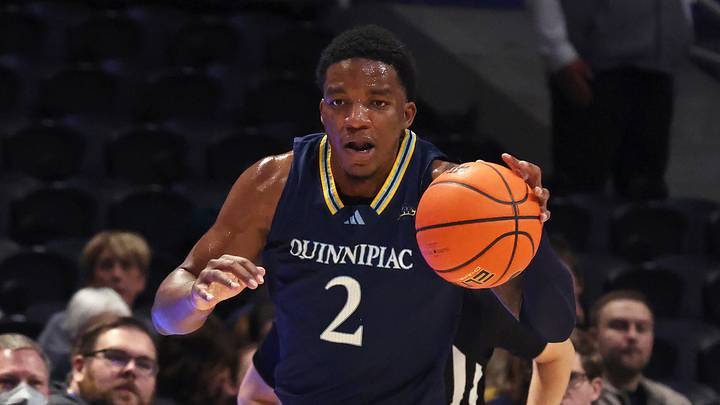
As Inside the Loud House anticipated would likely occur, Syracuse basketball transfer forward Amarri Monroe has filed a lawsuit against the NCAA as he attempts to play for the Orange in the 2026-27 season.
Syracuse.com first reported on Monroe's lawsuit that was filed on Monday in the New York State Supreme Court for Onondaga County. One of Monroe's attorneys, associate Steven Eychner of the law firm Newman & Lickstein LLP in Syracuse, confirmed to Inside the Loud House that the lawsuit had been filed.
Eychner said that his law firm isn't making any public comments about the case until at least the first court appearance on the temporary restraining order ("TRO") that Monroe's lawsuit is seeking. Eychner says his firm will know the date of the first court appearance in the coming days. Supreme Court Justice Jean Marie Westlake has been assigned to this case.
The decision by the 6-foot-7, 230-pound Monroe to file his own lawsuit at the state level comes as other class of 2022 athletes are taking similar measures around the country. This stems from the NCAA's new 5-for-5 eligibility model, approved in late June, that doesn't allow 2022 athletes who have already played four seasons in college to have a fifth year of eligibility.
Monroe played three seasons at Quinnipiac and, before that, one campaign at Wofford. Thus, he's not eligible to play for the Orange in the 2026-27 season, according to the NCAA. In late July, U.S. District Court of Colorado Judge Charlotte Sweeney issued a class-wide injunction that provided 2022 athletes with a fifth season of eligibility, provided they wanted one and with certain parameters.
However, on August 21, the U.S. Court of Appeals for the Tenth Circuit in Denver granted the NCAA's request to stay (i.e., temporarily pause) Sweeney's preliminary injunction as the appeal process plays out, which could take weeks or even months to move along.
As a result, legal experts have told Inside the Loud House that with the federal case (Wisne v. NCAA) headed toward appeal, and the outcome unknown, 2022 athletes such as Monroe and Syracuse football wide receiver Justus Ross-Simmons should strongly consider filing their own lawsuits in state court or attaching their names to an existing injunction at the state level. Word came out last week that Ross-Simmons had done so, and now Monroe has, too.
Key takeaways from Syracuse basketball transfer forward Amarri Monroe's lawsuit against the NCAA.
Inside the Loud House reviewed the documents related to Monroe's lawsuit against the NCAA on Monday. The lawsuit and related documents note that the Orange wants Monroe to play for the 'Cuse in 2026-27, and that Monroe wishes to compete for SU.
Attorneys for Monroe write that the NCAA, in approving its new 5-for-5 eligibility model, "arbitrarily denied Monroe and the rest of the class of 2022 the benefit of its new rules merely because Monroe and others had complied with pre-existing NCAA eligibility rules."
NCAA attorneys have argued, generally speaking, that allowing 2022 athletes a fifth season of eligibility could have repercussions for, among others, incoming freshmen who could potentially see their roster spots taken away by 2022 athletes.
Monroe, per the lawsuit and supporting documents, "seeks declaratory and injunctive relief restraining the NCAA from enforcing its old eligibility rules and its transition provisions to prohibit him from competing during the 2026-27 academic year, from interfering with Syracuse’s decision to permit him to practice and compete, and from imposing or threatening sanctions or other adverse consequences against Syracuse or others for complying with an Order of this Court."
The lawsuit notes that Monroe has never played professionally nor signed a pro contract. It says that he has "persevered through difficult seasons, injury, mental illness, and other hardships over the course of four (4) academic years, all (while) remaining academically eligible and earning a bachelor’s degree in Communications from Quinnipiac University."
In the spring, Quinnipiac filed a hardship waiver request on behalf of Monroe, seeking another season of eligibility "due to hardships incurred during the 2022-23 season at Wofford. The NCAA denied that waiver request and its appeal, filed in or around July 2026."
According to reports at the time, the 23-year-old Monroe, who grew up in Newburgh, N.Y., entered the transfer portal during the April window for Division I men's basketball players, and he was receiving interest from Syracuse basketball and various other programs.
Monroe's lawsuit notes that New York law "prohibits agreements and arrangements that restrain competition within this State" and also that "New York has separately declared by statute that the NCAA may not prevent a student-athlete from earning compensation for the use of the student-athlete’s name, image, or likeness."
As part of the lawsuit, there is an "AFFIRMATION OF AMARRI TICE a/k/a AMARRI MONROE" document. Monroe says that he has enrolled at SU and moved into student housing.
He acknowledges that the preliminary injunction in the Wisne v. NCAA case has been stayed, and that, as a result, Monroe filed this lawsuit on Monday to be able to compete in the 2026-27 season.
Monroe says he has signed a financial aid agreement with Syracuse to play for the Orange. He adds that "Syracuse has also provided me with an agreement concerning the use of my name, image, and likeness in connection with my participation in its basketball program. ... The compensation available to me under that agreement is worth hundreds of thousands of dollars and is contingent upon my eligibility to participate in men’s basketball for Syracuse."
Monroe notes the urgency in that SU's fall semester has already begun. He says he wants to pursue a professional basketball career, and "Another season of Division I basketball at Syracuse would give me an additional opportunity to develop, compete against high-level competition, and be evaluated by professional scouts and other basketball personnel."
Monroe states, "Every day that passes matters. Being part of a basketball team is not limited to
appearing in games. It includes practicing, training, learning the system, working with coaches,
developing relationships and timing with teammates, competing for a role, and preparing together
for the season. If I am prevented from doing those things now, I cannot simply get that time back
later. Each day that passes that I am away from the team makes it more difficult for me to integrate
into the team once I am able."
Inside the Loud House will continue to track Monroe's lawsuit and remain in touch with his legal team at Newman & Lickstein LLP.
 Add us as a preferred source on Google