

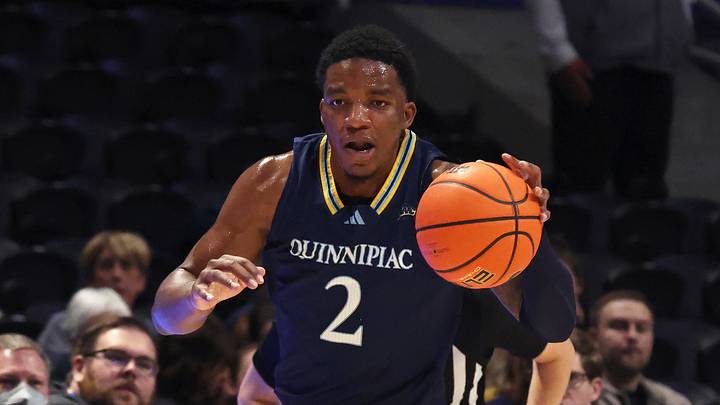
An eligibility hearing for Syracuse basketball transfer forward Amarri Monroe took place on Thursday, but the judge in his case didn't issue a ruling.
In late August, the 6-foot-7, 230-pound Monroe filed a lawsuit against the NCAA in the New York State Supreme Court for Onondaga County. On September 1, Monroe was granted a temporary restraining order ("TRO") by the judge in his case, Supreme Court Justice Jean Marie Westlake.
On Thursday, the hearing was to determine whether Monroe would receive a preliminary injunction, which is something that he needs to continue practicing with the Orange while his case plays out. At Thursday's hearing, Westlake didn't issue a decision.
The law firm of Newman & Lickstein LLP in Syracuse is representing Monroe in his case. Steven Eychner, an associate at Newman & Lickstein, tells Inside the Loud House that Westlake would issue a written decision as soon as she could. Eychner says it should be several days for that to likely occur.
Transfer forward Amarri Monroe has been practicing with Syracuse basketball lately.
The TRO issued at the beginning of September has allowed Monroe to practice with the Orange for now, but if he doesn't receive a preliminary injunction, he would be ineligible as his lawsuit carries on. That's problematic, because it's possible that his case would drag on past the end of the upcoming 2026-27 season.
The 23-year-old Monroe, who hails from Newburgh, N.Y., played the past three seasons for Quinnipiac and then one campaign before that at Wofford. The NCAA's new 5-for-5 eligibility model, approved in late June, doesn't grant class of 2022 athletes a fifth season of eligibility if they've already played four years in college.
On August 21, the U.S. Court of Appeals for the Tenth Circuit in Denver granted the NCAA's request to stay (i.e., temporarily pause) a preliminary class-wide injunction for 2022 athletes that was issued in late July by U.S. District Court of Colorado Judge Charlotte Sweeney. That stay has led more 2022 athletes to file their own lawsuits in state courts around the country, or attach their names to existing injunctions at the state level.
However, as Inside the Loud House has noted in recent articles, the NCAA has picked up some favorable outcomes in recent weeks, both in the federal case in Colorado, as well as in various state cases, where TROs and/or preliminary injunctions in favor of 2022 athletes have been stayed or denied. Legal experts have told Inside the Loud House that this is something to monitor.
Monroe, meanwhile, has said in court documents that he's enrolled at SU, moved into student housing, signed a financial aid agreement to play for the 'Cuse and that the Orange program has provided him with an NIL agreement worth hundreds of thousands of dollars, but that is contingent upon his eligibility to play for Syracuse basketball.
 Add us as a preferred source on Google