

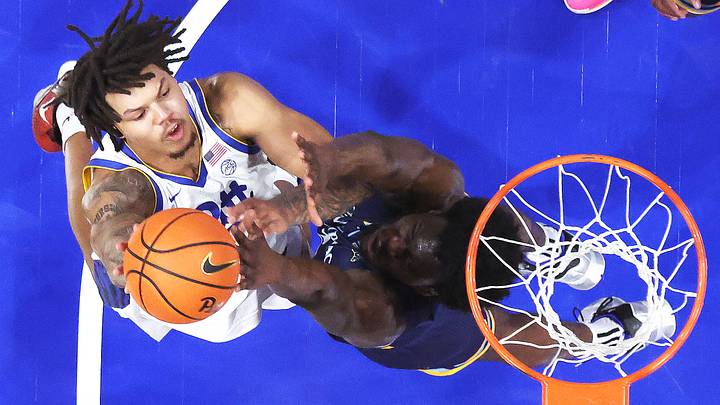
Transfer forward Amarri Monroe, who earlier this week filed a lawsuit against the NCAA in hopes of playing for Syracuse basketball during the upcoming season, is able to practice with the Orange after the judge in his case issued a temporary restraining order ("TRO") on September 1.
Naturally, that's an encouraging step for the 6-foot-7, 230-pound Monroe. The law firm of Newman & Lickstein LLP in Syracuse filed Monroe's lawsuit against the NCAA in the New York State Supreme Court for Onondaga County on Monday.
According to court documents, Supreme Court Justice Jean Marie Westlake, who is assigned to Monroe's case, has set a date of Thursday, Sept. 17, for a preliminary injunction hearing. One of Monroe's attorneys, associate Steven Eychner of Newman & Lickstein, confirmed to Inside the Loud House that the first court appearance is September 17, and that Monroe can practice with the 'Cuse for the time being.
The 23-year-old Monroe, who grew up in Newburgh, N.Y., played the past three seasons for Quinnipiac and then one campaign before that at Wofford. He is a class of 2022 athlete, and the NCAA's new 5-for-5 eligibility model, approved in late June, doesn't grant a fifth season to 2022 athletes who have already played four seasons in college.
Given what's transpired at the federal level lately in ongoing litigation involving 2022 athletes and the NCAA, legal experts have said to Inside the Loud House that Monroe needed to strongly consider filing his own lawsuit in a state court or attaching his name to an existing injunction at the state level.
For now, transfer forward Amarri Monroe can practice with Syracuse basketball.
Orange fans will be closely watching the outcome of Monroe's preliminary injunction hearing. If he receives a preliminary injunction, that would be another positive step in Monroe's attempt to play for first-year head coach Gerry McNamara in the 2026-27 season.
However, it's important to keep in mind that even if Monroe gets a preliminary injunction, the NCAA can request to have that preliminary injunction stayed (i.e., temporarily paused) while the case plays out in the New York State Supreme Court for Onondaga County.
The Tennessee Court of Appeals has issued an order staying the injunction granted to the plaintiff athletes pending appeal.
— Sam C. Ehrlich (@samcehrlich) August 26, 2026
As with Ohio, those players are now ineligible unless and until the Court of Appeals rules in their favor. pic.twitter.com/l6LdAGCYj2
While plaintiffs in some state-level cases have had favorable outcomes in recent weeks, the NCAA has also had some outcomes in its favor at the state level, such as in Ohio, South Carolina and Tennessee, for example.
We have a ruling on the NCAA's motion for a stay -- not that one though.
— Sam C. Ehrlich (@samcehrlich) August 17, 2026
The Ohio Court of Appeals has GRANTED the NCAA's motion to stay the injunction granted in Borovicanin v. NCAA, stopping the injunction from taking effect until the appeal is resolved. pic.twitter.com/qHyE1Zf33U
Plus, on August 21, the U.S. Court of Appeals for the Tenth Circuit in Denver granted the NCAA's request to stay a preliminary class-wide injunction for 2022 athletes that was issued in late July by U.S. District Court of Colorado Judge Charlotte Sweeney. That stay has led to more 2022 athletes filing their own lawsuits in state courts around the country.
This is something to monitor, amid several Syracuse players who are 2022 athletes and eye a fifth season. An attorney told me last week that if more and more TROs/preliminary injunctions are denied and/or stayed, with the merits aspect being cited, that could become problematic. https://t.co/2ljWxLpqL5
— InsideTheLoudHouse (@LoudHouseFS) September 2, 2026
When it comes to a preliminary injunction, the plaintiff has to show four things: A likelihood of winning the case on its merits, irreparable harm, that the harm to the plaintiff outweighs harm to the defendant, and the overall public interest and/or community welfare would be best served by the injunction being granted.
In recent days, Inside the Loud House has spoken with several legal experts, on background, about this. One attorney, who is not involved in Monroe's case, said it's critical to look at what judges are citing when preliminary injunctions are denied or stayed.
If a pattern emerges in which the NCAA is prevailing in state-level eligibility cases because judges deem that the NCAA has a high likelihood of success based on the merits of the underlying cases, as opposed to the plaintiffs, that's something to monitor.
Cases will be looked at differently from state to state, and if, for example, 10 injunctions are stayed but they have different reasons for being paused, that's one thing, this attorney said to Inside the Loud House. Yet if there is a consistent theme of why preliminary injunctions are being paused and/or initially denied - and that theme centers on the merits component - it could be problematic.
That's not to say Monroe won't have a positive outcome with his lawsuit. Only time will tell. But it's also not a slam-dunk that his preliminary injunction will be granted, or if such an injunction is granted, that it will hold, so to speak, for the entire 2026-27 season.
Monroe says in court documents related to his lawsuit that he has enrolled at SU, moved into student housing, signed a financial aid agreement to play for the Orange and that "Syracuse has also provided me with an agreement concerning the use of my name, image, and likeness in connection with my participation in its basketball program. ... The compensation available to me under that agreement is worth hundreds of thousands of dollars and is contingent upon my eligibility to participate in men’s basketball for Syracuse."
 Add us as a preferred source on Google